CTASouthObservatory#
- class tilepy.include.Observatories.CTASouthObservatory[source] [edit on github]#
Bases:
objectCoordinates and site information for the CTAO-South Observatory.
The CTAO-South Observatory is located in the Atacama Desert in Chile, about 10 km southeast of the ESO Paranal Observatory. This remote desert site is one of the driest places on Earth, providing excellent observing conditions for very high-energy gamma-ray astronomy.
Latitude: -24.5°
Longitude: -70.3°
Altitude: 2653 m
The southern array is designed to detect gamma rays from 150 GeV up to 300 TeV, covering the highest energies accessible from the ground and focusing mainly on Galactic sources .
The initial array, called the
Alpha Configuration, includes:14 Medium-Sized Telescopes (MSTs), covering energies from 150 GeV to 5 TeV,
37 Small-Sized Telescopes (SSTs), which extend sensitivity above 5 TeV, and the full array covers about 3 km \(^{2}\).
The SSTs use a dual-mirror design with silicon photomultiplier (SiPM) cameras and a wide field of view (about 8.8 degrees). The MSTs have 12 m mirrors and fast PMT-based cameras (FlashCam), with a field of view of about 8 degrees. The CTAO-South site is built to explore some of the most powerful particle accelerators in our Galaxy, such as supernova remnants, pulsar wind nebulae, and massive star clusters [1].
There is no Large-Sized Telescopes (LSTs) are installed at CTAO-South for now, but the site is prepared for future LST additions.
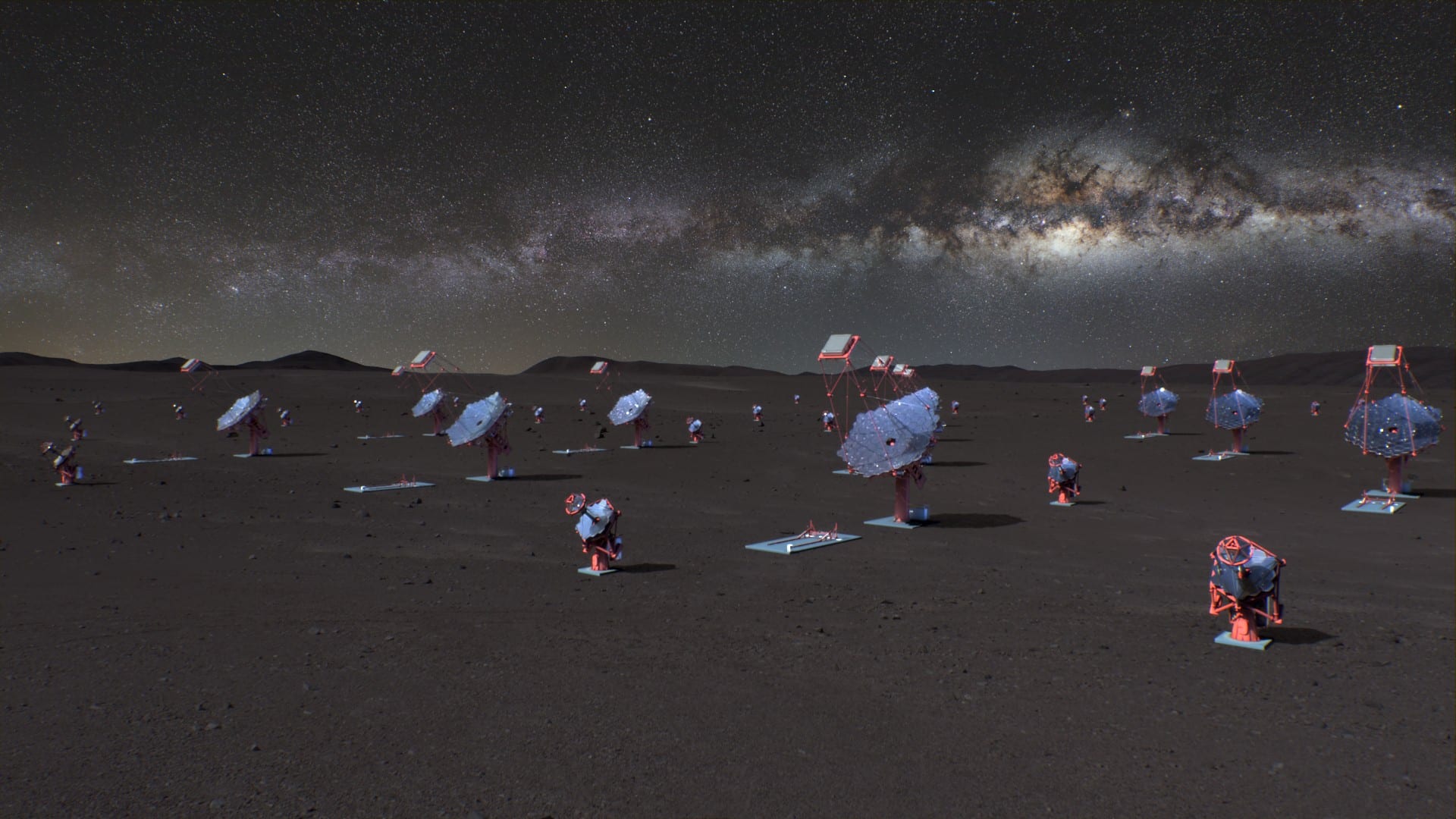
An artistic illustration of the proposed CTA (credit: Gabriel Pérez Diaz, IAC / Marc-André Besel.#
References